

Epic Games Goes All-In on 'Vibe Coding': How AI Agents Rebuilt the Launcher and Unlocked Linux Support
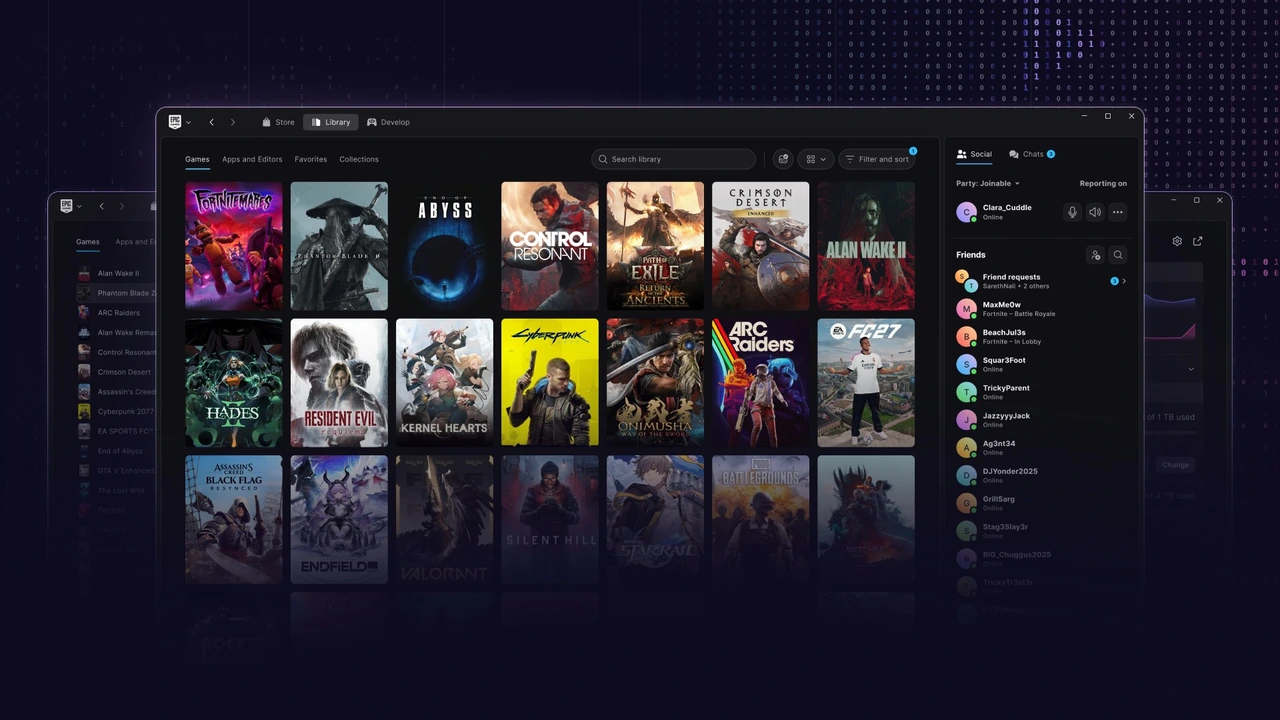
Epic Games launched a preview of its completely rebuilt PC launcher, crafted entirely through 'vibe coding' and AI agents. Delivering radical speed boosts, modernized multiplatform architecture, and long-awaited Linux support, this release signals a major turning point in commercial software development.
Key Takeaways
- Epic Games rolled out a ground-up preview rewrite of its launcher that is substantially faster, more responsive, and natively supports Linux.
- The client was officially 'vibe coded' using AI coding agents that generated and reviewed all application code under engineering supervision.
- CEO Tim Sweeney announced an internal engineering pivot to retrain development teams around AI-accelerated workflows across Epic's entire portfolio and Unreal Engine.
- Internal technical directives signal an end to hand-written code, positioning AI agents as primary builders while software engineers transition into high-level architects and validators.
- Native Linux compatibility clears technical hurdles to bring Fortnite and the Epic Games Store to Linux distributions and gaming handhelds.
On October 14, 2026, Epic Games surprised the tech industry by previewing a complete overhaul of its PC gaming launcher. The newly announced app promises dramatically faster startup times and finally brings native Linux support. However, what caught the attention of software architects worldwide was how the application was engineered: it was entirely 'vibe coded' through autonomous AI agents.
'Coding is hard,' Epic stated candidly in its announcement. 'So instead of doing that, we vibe coded a new Epic Games Launcher that's dramatically faster and more responsive than the current one, and has an updated design.' Rather than being an isolated stunt, the preview marks the first public milestone of an enterprise-wide pivot championed by CEO Tim Sweeney, who confirmed an internal restructuring to retrain staff for full AI acceleration across all ongoing projects and Unreal Engine tooling.
At Nubework, we analyze how Epic's milestone validates the shift from artisanal manual coding toward agentic software engineering—where multi-agent systems handle code conversion, boilerplate, and cross-platform compilation while senior architects orchestrate system design, API contracts, and rigorous security verification.
Demystifying 'Vibe Coding' at Enterprise Scale
Originally popularized by Andrej Karpathy to describe prompting an AI to write software while guiding the high-level intent, 'vibe coding' has graduated from hobbyist experiments to production reality. Martin Keely, VP and GM of Epic Games Store, told The Verge: 'We definitely had agents writing and checking all the code; we used them to replicate the core functionality of the existing launcher.' Engineers were not hand-typing UI layouts and system bindings; instead, they steered autonomous agents through test harnesses and specification loops.
Tim Sweeney's Mandate: The End of Hand-Written Code
The launcher rollout coincides with internal company memos indicating that Epic Games is transitioning away from manual coding across major divisions. Tim Sweeney clarified that the goal 'is not doing the same work with fewer people, but enabling everyone to build MORE and BETTER software.' In the era of autonomous agents, competitive advantage is no longer measured in lines of code written per day, but in architectural rigor, prompt engineering discipline, and robust automated integration testing.
Linux Parity and the Path for Fortnite on Open Systems
One of the preview's most significant achievements is native Linux support. Historically, maintaining cross-platform parity between Windows, macOS, and Linux created high maintenance overhead. By utilizing agentic translation and automated system-call bridging, Epic managed to deliver native Linux binaries alongside modern interface rendering. This infrastructure lays the groundwork for launching Fortnite natively on Linux distributions and handheld devices like the Steam Deck.
Enterprise Takeaways: Modernizing Legacy Software with AI Agents
For engineering leadership and CTOs, Epic's experience provides a compelling blueprint: multi-decade legacy software burdened by technical debt can be refactored and ported rapidly when paired with supervised AI agent swarms. At Nubework, we partner with enterprises to adopt agentic development workflows, helping organizations modernize monolithic applications, accelerate clean code migration, and deploy resilient digital platforms in record time.
Sources
Want to apply this in your organization?
Talk to a Nubework architect.
Related Articles
Agentic AI
Anthropic Warns of Self-Replicating AI Worms Colonizing Smart IoT Devices
Agentic AI
Google Antigravity and Gemini 4 Argon: The Quantum Leap in Autonomous Agents and Enterprise Software Engineering
Agentic AI